The Second Meaning Doing the Heavy Lifting
Learn how a joke’s second meaning turns an ordinary line into a comic pivot, and spot the small cues that prepare the shift before the punchline lands.
The most common mistake when reading a joke is to treat its punchline as a surprise dropped from nowhere. That misses the work done by the line before it: the setup invites one interpretation, then a later word or phrase makes another interpretation suddenly fit. A reader who spots that preparation can hear not just the surprise, but why the joke feels earned.
Second meaning comedy begins with an ordinary reading
Second meaning comedy uses a line that can be understood in more than one way. At first, the audience follows the meaning that best fits the situation. Then a cue—often a single word—pushes the line toward a different meaning, and the audience revises what it thought it heard.
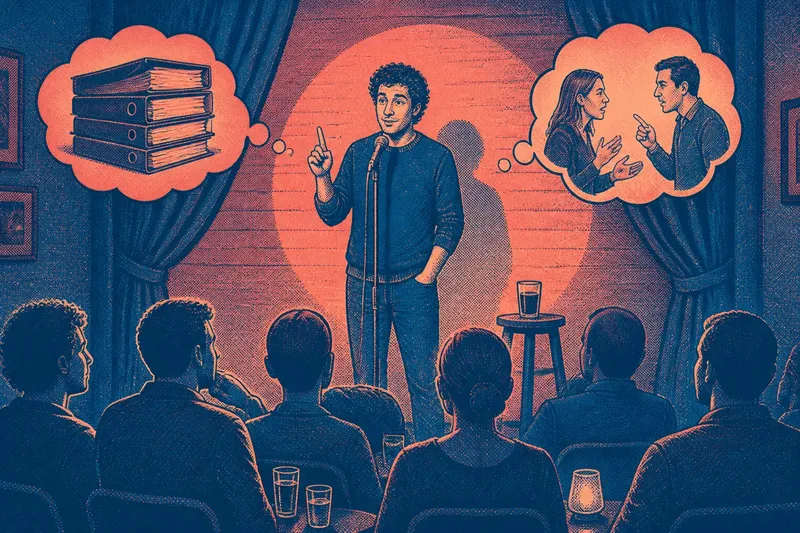
Consider an invented exchange. A person carrying a stack of folders says, “I’m trying to keep my cases together.” The first reading is practical: the folders contain cases, and the speaker is keeping them organized. If a colleague replies, “Then stop taking them personally,” the word “cases” acquires a second, more emotional sense. The joke turns on the shift from paperwork to personal disputes.
The line does not need to contain a formal pun. A word can carry two dictionary meanings, but a phrase can also change meaning because of its context, tone, or implied subject. What matters is that the audience can connect both readings to the same wording without being asked to ignore the scene.
The setup quietly narrows the first interpretation
A successful turn usually begins by making one reading feel natural. The writer supplies a setting, object, or problem that gives the audience a reason to choose it. A mechanic talking about a “rough idle” steers attention toward a car; a musician using the same phrase might be discussing a restless audience. The surrounding details act like tracks for the first interpretation.
That guidance should be strong enough to make the initial reading easy, but not so forceful that the second reading seems impossible. If every detail points only to a car engine, a later remark about an audience may feel like a new subject rather than a turn. A small opening remains: perhaps a mention of the driver, a quiet cabin, or an unusually long wait gives the alternate sense somewhere to attach.
Writers often prepare that opening with a word that has a second use, a familiar expression that can be taken literally, or a phrase with an unstated object. The audience does not have to notice the opening in advance. In fact, the setup may work best when the first reading feels complete enough to occupy attention.
The pivot changes what the audience thinks the line refers to
The pivot is the moment that makes the second reading available. It may be the punchline itself, a final word, a reaction, or a detail that reframes what came before. The timing matters because the audience needs to hold the first reading long enough for the contrast to register.
A pivot can work in several ways:
- One word changes sense. A familiar term shifts from one meaning to another without changing its sound.
- A phrase becomes literal. An expression normally used figuratively is treated as a physical fact.
- The subject changes. The audience realizes that “he,” “it,” or “they” referred to someone or something different than expected.
- A response supplies missing context. A brief reply makes an earlier line sound as though it belonged to a different conversation.
For instance, imagine a person at a library asking, “Can you help me find a quiet place?” The librarian points to a map of the building. The first reading is a request for a calm study area; a follow-up such as “I meant somewhere my thoughts will stop arguing” shifts “quiet” from the room to the speaker’s mind. The turn is prepared by the ordinary ambiguity of “quiet place,” while the added phrase supplies the alternate frame.
How can you tell whether the turn was prepared?
Which word carries both readings?
Find the word or phrase that changes meaning after the pivot. If no specific wording can carry both interpretations, the laugh may depend on an unrelated surprise rather than a second meaning. The connection should be explainable in plain language.
What made the first reading feel likely?
Look at the concrete details immediately before the turn: the setting, the topic, and what the speaker appears to want. Those clues should point toward the initial interpretation without making the alternate one unusable.
What new detail unlocks the alternate reading?
Identify the exact cue that changes the audience’s understanding. It might be the last word of a sentence, a reply, a gesture, or a newly revealed subject; if the cue arrives too late to connect, the turn can feel arbitrary.
Can the earlier line still be heard both ways?
After the punchline, mentally replay the setup. A well-prepared line often supports both readings, even though the audience noticed only one at first. If the second reading requires replacing the original wording with different words, the joke may be relying on explanation rather than its own construction.
Revision depends on the kind of turn
When a line feels muddy, first separate the setup from the pivot. Write down the initial reading in a few words, then write the alternate reading. This is not a formula for making every joke; it is a way to see whether the two meanings are attached to the same phrase and whether the setup gives the first one enough support.
If the second reading is hard to state, the pivot may be vague. If the first reading is weak, add a relevant detail before the turn rather than explaining the joke afterward. If the two readings are clear but the line feels slow, remove words between the setup and the cue that do not strengthen either meaning.
Say you have an invented draft: “The baker said his schedule was packed.” The intended turn is that he has too much work, while “packed” also suggests tightly filled pastries. If the scene mentions only an office calendar, the pastry reading may arrive without support. Adding a brief mention of trays before the line could prepare it; the expected result is that listeners have both the schedule and the baked goods in mind when “packed” lands.
Not every possible meaning deserves a place in a joke. Chasing a remote dictionary definition or adding several hints can make the setup feel like a puzzle assembled to defend the punchline. One clear first reading and one plausible alternative usually give the audience more room to enjoy the turn.
Delivery can preserve or spoil the double reading
Performance is part of the construction. If a speaker stresses the pivot word too heavily, the audience may guess the trick before the line has established its first meaning. If the performer rushes through the setup, listeners may miss the context that makes the alternate interpretation legible.
A neutral delivery can help a line keep both meanings alive. That does not mean every joke should be spoken flatly: a pause, glance, or change in tone can provide the pivot. The useful question is whether the performance tells the audience how to read the line before the wording has done its work.
In written comedy, punctuation and sentence order can do some of the same work. A delayed final word may hold the first reading in place; an early hint may make the turn too easy to anticipate. Read the line aloud, then read it without acting. If the second meaning appears only through an exaggerated voice or gesture, consider whether the wording itself needs clearer preparation.
Second meaning comedy rewards a replay
Second meaning comedy works because the audience performs a quick correction: the words stay put, but their relationship to the situation changes. To spot the craft, name the first reading, find the pivot, then check whether the same line can support the second reading after the fact.
That small replay is useful beyond wordplay. It can reveal how a comic scene uses an assumption about who is speaking, what a phrase refers to, or what kind of conversation is taking place. Listen for the clue that made the turn possible, not only the word that drew the laugh; the preparation is where the joke’s second meaning earns its place.