A Living Room Comedy Night, Arranged by Contrast
Plan a living room comedy night with a clear mix of comic styles, an easy running order, and simple ways to adjust when the room’s mood changes.
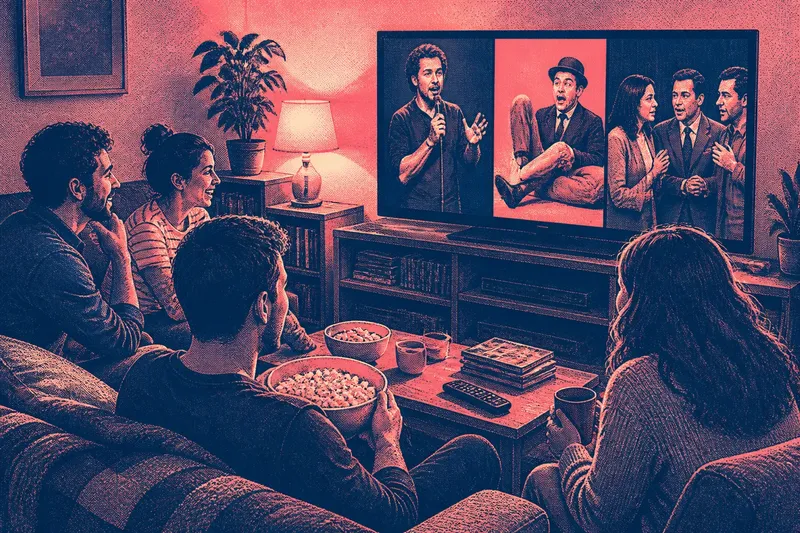
The common mistake in planning a living room comedy night is stacking pieces with the same comic rhythm: one quick-fire set after another, or a run of similarly awkward scenes. Even a strong selection can lose its surprise when the next piece does the same work. Arrange the evening by contrast so each selection gives the room a different way to listen and laugh.
Choose the evening’s shape before selecting clips
Start with the people in the room and the kind of attention they are likely to bring. A casual gathering may suit short, self-contained pieces; a group that enjoys following a story may prefer one longer work, with a brief change of pace around it. Decide whether the night is built around clips, full episodes, stand-up segments, or a mix. The format determines how much variety you can introduce without making the evening feel like channel surfing.
Pick a comfortable stopping point before you start. You do not need a rigid schedule; just decide whether you want a compact session or an open-ended hangout. Leave room for conversation and for people to opt out of watching without making them feel they have interrupted a performance.
Build a small menu of different comic energies
Choose a few pieces that differ in how they make an audience laugh. Useful contrasts include:
- Fast and verbal: Dense wordplay, quick reversals, or brisk stand-up. If the room is alert and enjoying rapid jokes, keep this kind of piece in the queue; if people are missing lines, switch to something more visual or slower.
- Slow and physical: Pauses, facial reactions, awkward movement, or a visual gag that takes time to unfold. If guests are talking over dialogue, choose a physical sequence; if the slow build loses their attention, move to a more compact piece.
- Ensemble and solitary: A scene driven by people interrupting and responding, followed by a performer carrying the room alone. If overlapping voices are easy to follow, keep the ensemble piece; if they become hard to hear, switch to a solo performance.
- Familiar and strange: A recognizable social situation beside an absurd or surreal premise. If the group responds to recognizable details, choose the familiar setup; if it feels too predictable, try the stranger premise.
- Warm and pointed: Affectionate character comedy beside satire with a sharper target. If the room seems comfortable with pointed humor, include the satire; if its target or tone feels unwelcome, choose the warmer piece instead.
- Story and sketch: A scene that develops a character or premise beside a short sketch built around one comic turn. If guests want a thread to follow, choose the story; if attention is scattered, choose the self-contained sketch.
These are not boxes to tick in every session. Use them to notice whether your choices are doing the same job. A change in performer alone may not create much contrast if timing, tone, and joke structure remain alike.
Keep each selection easy to identify and cue. Put links or discs in a simple order, check that you can reach them without searching, and note where each piece begins and ends. Avoid building the night around material that needs a long explanation before it makes sense. The audience should be able to enter the joke, not sit through a briefing.
Arrange the running order by changing one quality at a time
Open with something accessible and clear enough to settle the room. It can be lively, but it does not need to be the loudest or most demanding choice. Follow it with a piece that changes one major quality: after rapid dialogue, try a visual sequence; after an ensemble scene, choose a solo voice. A single clear shift helps the next piece register without making the evening feel assembled at random.
Then consider how the room is responding. If attention is thinning, a concise, energetic selection may restore focus. If people are already laughing loudly and talking over one another, a quieter piece can give them a different kind of attention. Place the most demanding or tonally sharp material where the group has enough patience for it, rather than treating it as an automatic finale.
Say you have a quick stand-up segment, a slow physical scene, and a tightly scripted ensemble exchange. Begin with the stand-up to establish the room, move to the physical scene to slow the rhythm, then play the ensemble piece, whose overlapping reactions create a fresh burst of energy. The starting materials are three distinct forms; the actual steps are to cue them in that order and leave a pause between selections. The observable result to watch for is whether the shift in rhythm brings attention back; if the ensemble’s overlapping lines are hard to hear, replace it with a solo piece instead.
Use transitions that let the next style arrive
After a piece ends, let the laugh finish. A pause, a refill, or a short conversation can clear the room’s attention before the next selection. Avoid explaining why the previous piece was clever or telling everyone what to look for next; that commentary can narrow the audience’s response and make the next joke feel like an assignment.
If you introduce a selection, offer only the context needed to follow it: perhaps that it is a character scene, a monologue, or a clip with a slow build. Keep the framing neutral. Let the performance supply its own target, point of view, and rhythm.
Adjust the sequence without turning it into a show
Watch for signs that a selection is not fitting the room: people are checking out, conversation is drowning out quieter lines, or a tonal shift has left guests unsure how to respond. You do not need to defend the planned order. Skip ahead, take a break, or replace a piece with something shorter. A host’s job is to keep the shared experience comfortable, not to prove that every choice deserved its place.
It is not worth spending the evening hunting down a perfect obscure clip or arranging every transition with theatrical precision. A clear queue and a few meaningful contrasts will serve the gathering better than elaborate curation. Keep the material you want to watch, and make the controls easy to reach.
What helps when the room’s taste is mixed?
How many styles should a living room comedy night include?
Choose enough variety for the evening to change texture, but not so many forms that every selection feels like a sample. A few well-separated comic energies are easier to follow than a rapid parade of unrelated clips.
Should the host explain the joke before playing a clip?
Usually, give only essential context, such as who a character is or where a scene begins. Explaining the joke’s mechanism can pre-empt the audience’s own discovery.
What if one person dislikes a selection?
Offer a low-pressure way to pass, step away, or suggest a change without putting that person on the spot. Shared viewing works better when disagreement does not become a vote on someone’s taste.
How can you tell when to change pace?
Notice the room rather than relying on a fixed sequence: side conversations, distracted attention, or laughter that fades before a piece ends can all signal that a different rhythm may help. Treat those cues as prompts to adjust, not as a verdict on the material.
End with a piece that leaves the room space to talk
Choose the final selection for the kind of aftertaste you want, not simply because it is the biggest or loudest. A compact scene may leave people quoting a line; a gentler piece may make conversation easier; an unresolved comic premise may invite disagreement. Let the ending breathe, then ask what people noticed rather than whether they liked the night as a whole.
A living room comedy night arranged by contrast is less about presenting a definitive collection than about giving each comic voice space to sound like itself. Keep a note of which changes of pace felt natural to your group, and use that observation to make the next gathering more attentive, not more complicated.