The Fool, the Expert and the Rules They Break
The fool and expert comic characters expose hidden social rules. Learn to shape their motives, reactions and conflict into scenes with a sharper comic point.
The common mistake in writing fool and expert comic characters is to make one merely stupid and the other merely right. That turns conflict into a contest of competence and costs the scene its sharper question: who gets to decide which social rules matter? The fool treats a rule as optional or invisible; the expert knows it well enough to bend it with precision.
The fool makes an unwritten rule visible
A fool does not need to misunderstand every fact. Often, the character understands the literal instruction and misses—or refuses—the polite performance wrapped around it. Someone says, “Make yourself at home,” and the fool starts rearranging the host’s carefully set table. The laugh comes from treating a social invitation as an operating instruction.
For the writer, distinguish ignorance from indifference. Ignorance can be corrected by explanation. Indifference makes the other characters decide whether to explain, tolerate or punish the breach. That decision supplies the scene’s pressure.
- Observe which rule the room follows without stating aloud; if everyone adjusts their behavior around it, make that convention the pressure point, and if nobody’s behavior depends on it, choose a more consequential rule.
- Observe what the fool wants from the action; if convenience, curiosity, pride or a literal reading gives the move a clear motive, keep it, and if the motive is only “to be funny,” give the character a practical or emotional reason.
- Observe how another character reacts before the fool explains; if the reaction reveals discomfort, status or a need to enforce the rule, use it, and if it reveals nothing, give that character a specific stake.
- Observe what changes after the breach; if it alters the conversation or forces a decision, build the next beat around that consequence, and if nothing changes, revise the action or cut it.
- Observe whether the fool understands the convention; if the character genuinely misses it, let surprise shape the response, and if the character knowingly ignores it, make defiance or mischief the motive.
- Observe who benefits from the rule; if it protects someone’s authority or comfort, let that advantage become visible, and if nobody benefits, clarify why the room keeps the rule.
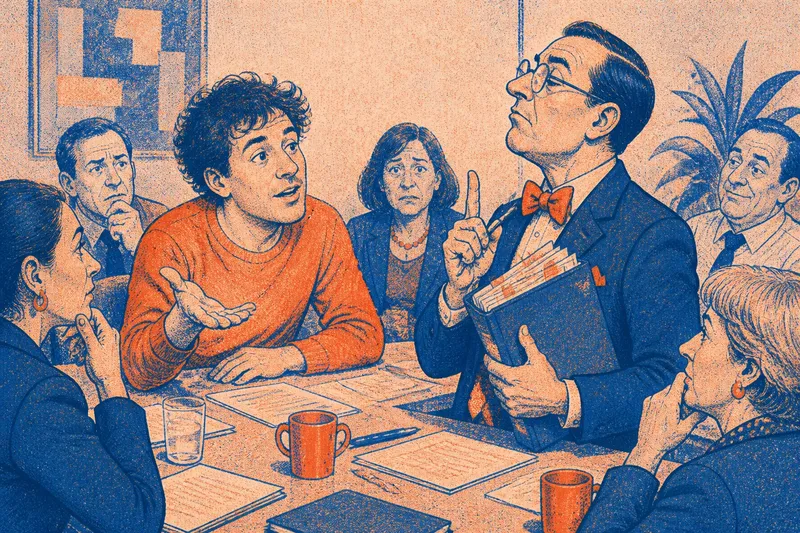
Say a committee has agreed to praise every proposal before raising objections. A new member hears the rule, then asks whether the proposal will actually work. The chair now has to choose between enforcing the ritual and answering the practical question. The bluntness reveals that the group’s agreement was partly a performance.
The expert turns knowledge into a social weapon
The comic expert follows rules closely but treats knowledge of them as permission to control everyone else. This character can name the proper procedure, correct a harmless detail and insist that a casual exchange has become official. The audience sees both the expertise and the disproportionate use of it.
Give the expert a legitimate point. If the character is wrong about everything, the scene has little tension. If the expert is right about a detail but wrong about its importance, the conflict can keep moving. Their knowledge should solve one problem while creating another: they know how to file a form but cannot let a colleague fill it in without commentary.
Specific vocabulary helps only when it clarifies the expert’s priorities. A stage manager who calls out the order of cues may be keeping a performance coherent. The comic turn arrives when the same exactness is applied to a trivial disagreement about who moved a chair. The rule stays intelligible; the expert’s sense of proportion becomes the target.
Opposing relationships to rules create shifting conflict
These roles work best as a mismatch, not a simple opposition between chaos and order. The fool may be socially perceptive and technically careless; the expert may be technically sharp and socially clumsy. Give each a strength the other lacks so the encounter can change direction instead of repeating the same correction.
One useful pattern is to let the fool break a convention that protects the expert’s status. The expert responds by citing procedure, and the fool asks a direct question the procedure cannot answer. Now the audience can see the rule doing two jobs: organizing the room and keeping someone in charge.
Another pattern reverses the advantage. The expert’s strictness can expose the fool’s convenient innocence. If the fool claims not to understand a boundary but clearly uses that claim to avoid responsibility, the expert’s insistence may be fair. The audience then laughs at the fool’s evasive performance, not at rule-breaking as an automatic virtue.
What should each character want besides the laugh?
Does the fool know they are breaking a rule?
Sometimes, but awareness should change the motive. A fool who genuinely misses a convention creates surprise; one who knowingly ignores it creates defiance or mischief. Decide which version drives the scene before writing the reaction.
Can an expert be funny while being right?
Yes. The expert can be correct about the rule and absurd about its priority, timing or reach. That keeps the character credible while giving the audience room to judge the behavior.
Who has more power in the room?
Power may come from a title, control of a resource or the group’s willingness to listen. Show it through behavior: who gets interrupted, who must explain and whose small mistake becomes everyone’s business.
What changes after the breach?
A strong comic beat leaves someone with a new problem: a plan is delayed, a private preference is exposed, or the expert has to defend a rule they usually enforce without discussion. If nothing changes, the joke may be only a character label.
Use reactions to reveal the room’s real code
The characters around the fool and expert are not just an audience inside the story. Their reactions tell us which rules are flexible and which carry a cost. A colleague who quietly fixes the mess signals one kind of tolerance; a colleague who looks to the boss before speaking signals another.
Keep those reactions distinct. If everyone gasps in the same way, the room becomes a chorus rather than a social system. One person can be amused, another embarrassed and a third pleased that someone finally challenged the procedure. That divided response creates a richer scene without adding another joke.
For performance, give the actor a playable choice rather than a broad label such as “awkward” or “bossy.” The fool might answer too promptly, as though the implication never arrived. The expert might pause to decide whether a minor breach deserves correction, then correct it anyway. Timing and restraint let the audience read each character’s relationship to the rule.
Keep the rule specific and the breach consequential
Not every convention deserves a scene. A rule should matter to someone present, even if the audience thinks its enforcement is ridiculous. If it has no effect on status, comfort, access or a shared task, breaking it may feel arbitrary. Give the characters something to protect, and the comic disagreement gains shape.
It is not worth explaining the entire social system before the joke begins. A familiar setting—a staff meeting, a dinner invitation or a rehearsal room—can carry much of that information. Show the rule through behavior, then let the fool or expert put pressure on it.
The fool and the expert remain useful comic characters because each reveals a different bargain: one refuses to perform the expected understanding, while the other insists that understanding confers authority. When shaping fool and expert comic characters, track who benefits from the rule, who pays for its breach and what changes in the room afterward. That is where the laughter can point beyond the character and toward the group that made the rule feel necessary.