Satire Is Not Just a Sharper Insult
Learn how satire turns a sharp insult into a comic scene with a clear target, a revealing pattern, and an ending that gives the audience something to see.
The common mistake in satire is to call a person foolish, land an insult, and assume the joke has exposed something. That shortcut can cost a scene its point. Strong satire makes a recognizable habit visible through comic action, so the audience can see more than the writer’s contempt.
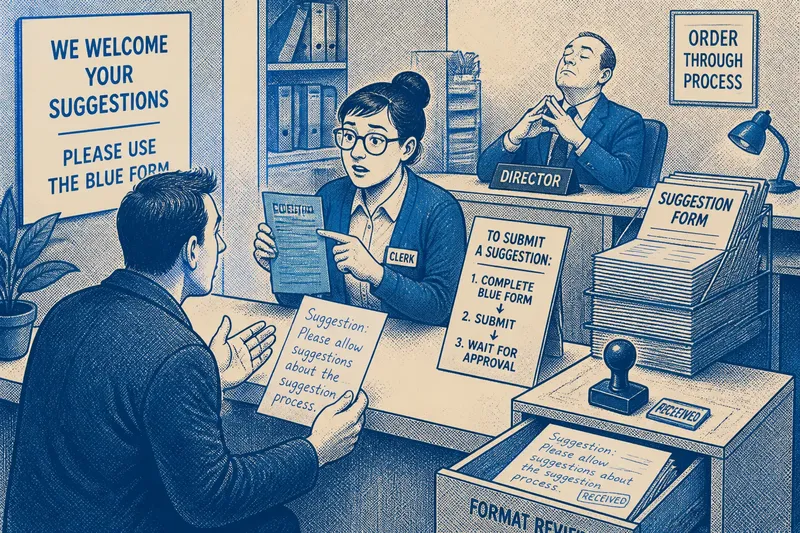
Imagine a fictional town office that accepts public suggestions only on a blue form, including suggestions about the blue forms. The director is not a cartoon villain; the office says the form keeps submissions organized. The comic opportunity lies in what happens when that tidy explanation meets an ordinary request.
Build the joke around a visible contradiction
Start with a claim the target makes about itself. The office says it welcomes suggestions. Then give the characters an action that puts the claim under pressure: a resident tries to submit a note, and the clerk points to the form requirement.
The scene does not need to announce that the rule is absurd. Let the clerk sincerely explain that suggestions are welcome, but only after the required form is submitted. The audience can hear the gap between the promise and the action.
That gap gives the joke a specific target: not paperwork in general, but a process that blocks the kind of feedback it claims to invite. A sharp line can name the contradiction, but the exchange gives it shape and comic momentum.
Give the satire a human point of view
Characters make the target more legible when they want different things. The director wants the office to appear orderly. The clerk wants to do the job without being blamed for an exception. The resident wants a suggestion heard. Those motives are invented for the scene, but each gives an actor something concrete to pursue.
Instead of making the director deliver a speech about fairness, let the director point to the form and insist that the same procedure applies to everyone. The clerk might try to help by finding a blank copy, only to discover that copies are issued after a suggestion is accepted. The resident can stay polite and ask how a suggestion gets accepted without the form. The comic pressure comes from the characters’ attempts to move forward, not from a lecture about their motives.
Distinct points of view also prevent the satire from collapsing into a personal attack. The scene can expose a self-defeating idea without treating one character’s appearance, accent, or private vulnerability as the joke. If removing an insult leaves the comic pattern intact, the insult may not be doing useful work.
Let repetition change what the audience sees
A contradiction can earn a laugh once; returning to it can make it mean more. In the imagined office, the resident asks for a form, and the clerk explains that forms are available only after a suggestion is approved. The resident asks how to submit a suggestion without a form. The director repeats that the office cannot consider anything outside the process.
Each return should add a new turn, not simply repeat the same line. The form first seems like a small inconvenience. Then the resident’s attempt to discuss the form becomes the very suggestion the office refuses to accept. By the last exchange, the audience sees a system that can absorb criticism without responding to it.
A useful revision question is: what changes each time the pattern returns? The answer might be the resident’s patience, the clerk’s attempted workaround, or the director’s increasingly polished explanation. If nothing changes, the repetition is probably only taking up space.
Choose a target the action can reveal
“People are ridiculous” is too broad to guide a scene. “An office says it welcomes suggestions but rejects suggestions that question its submission process” gives the writer something an audience can watch. The counter, the sign, and the stack of forms all serve the action rather than decorate a general complaint.
Satire does not have to solve the problem it depicts. It does need to make the comic target clear enough for the audience to understand what the scene is exposing. A possible remedy can help the writer sharpen that target, but it need not become the ending or the message of the scene.
For instance, the writer might consider whether the office could accept a suggestion in another format. That thought clarifies the gap between the stated goal and the rule; the scene can still end on the resident holding the rejected note rather than on a policy proposal.
How can you tell whether the scene is landing?
Does a satirical joke need to explain its target?
No. The characters’ choices and the consequences can make the target clear without a narrator spelling it out. If the audience cannot tell what behavior the joke is pointing at, make the action more specific.
Can satire work without a cruel character?
Yes. Confident explanations, repeated attempts to follow a rule, and a growing mismatch between a promise and an outcome can carry the comedy. Cruelty is a possible ingredient, not a requirement.
What makes a scene more than a pointed joke?
A pointed joke can make its observation in a single line. A satirical scene develops the observation through behavior, repetition, or consequence, letting the audience watch the pattern emerge.
How do you know if the target is too vague?
Name the behavior the scene exposes, then identify the action that makes it visible. If the answer is only a broad complaint about people, give the characters a more specific conflict to play.
End on an image that carries the point
In the invented office scene, the resident might leave with a blue form asking for suggestions about the forms. The clerk stamps the original note “received” and places it in a drawer marked “format review.” The image gives the audience a consequence to interpret: the office has turned a challenge to its process into another object for that process to contain.
What is not worth the effort is adding a speech after the audience has already seen the contradiction. Keep an explanatory line only if it reveals a character’s particular blind spot or changes the action. Otherwise, let the final image do the work.
Revise the scene with concrete decisions
Use these checks on the invented blue-form scene. Each observation points to a revision choice; if the scene does not meet the condition, try the alternative.
- Target: Check whether the action exposes the office’s claim that it welcomes suggestions while blocking them. If it does, keep the focus there; if not, give the resident a specific request the office rejects.
- Stated purpose: Check whether a character explains why the form exists. If the purpose is clear, let the action challenge it; if not, add a brief explanation that can be tested by the scene.
- Concrete action: Check whether the audience sees the resident try to submit a note. If the attempt is visible, build the exchange around it; if not, stage the attempt rather than summarize it.
- Character motives: Check whether the director, clerk, and resident each want something distinct. If their aims differ, preserve those choices; if they blur together, give each person a separate immediate goal.
- Repetition: Check whether each return changes the audience’s understanding or the characters’ situation. If it does, keep the return; if it only repeats a line, cut it or add a new consequence.
- Insult: Check whether the scene still exposes its target without its harshest personal jab. If it does, remove the jab; if it does not, add behavior that makes the pattern visible.
- Ending: Check whether the last action leaves a visible consequence. If it does, trust the image; if it does not, end on a choice or object that shows what the process has done.
In the fictional office, the chain is straightforward: the stated aim is to hear suggestions, the form is the obstacle, the resident’s rejected note makes the contradiction visible, and the drawer marked “format review” gives the pattern a final image. That is why the blue form matters. It lets the audience see the target in action, rather than asking them to accept an insult as the whole argument.
Satire is not just a sharper insult. The phrase is useful as a search for the scene’s purpose: what behavior can the audience recognize in the comic action, and what image will leave that recognition intact after the laugh?